Culturally Responsive Teaching: Indigenous Peoples Edition
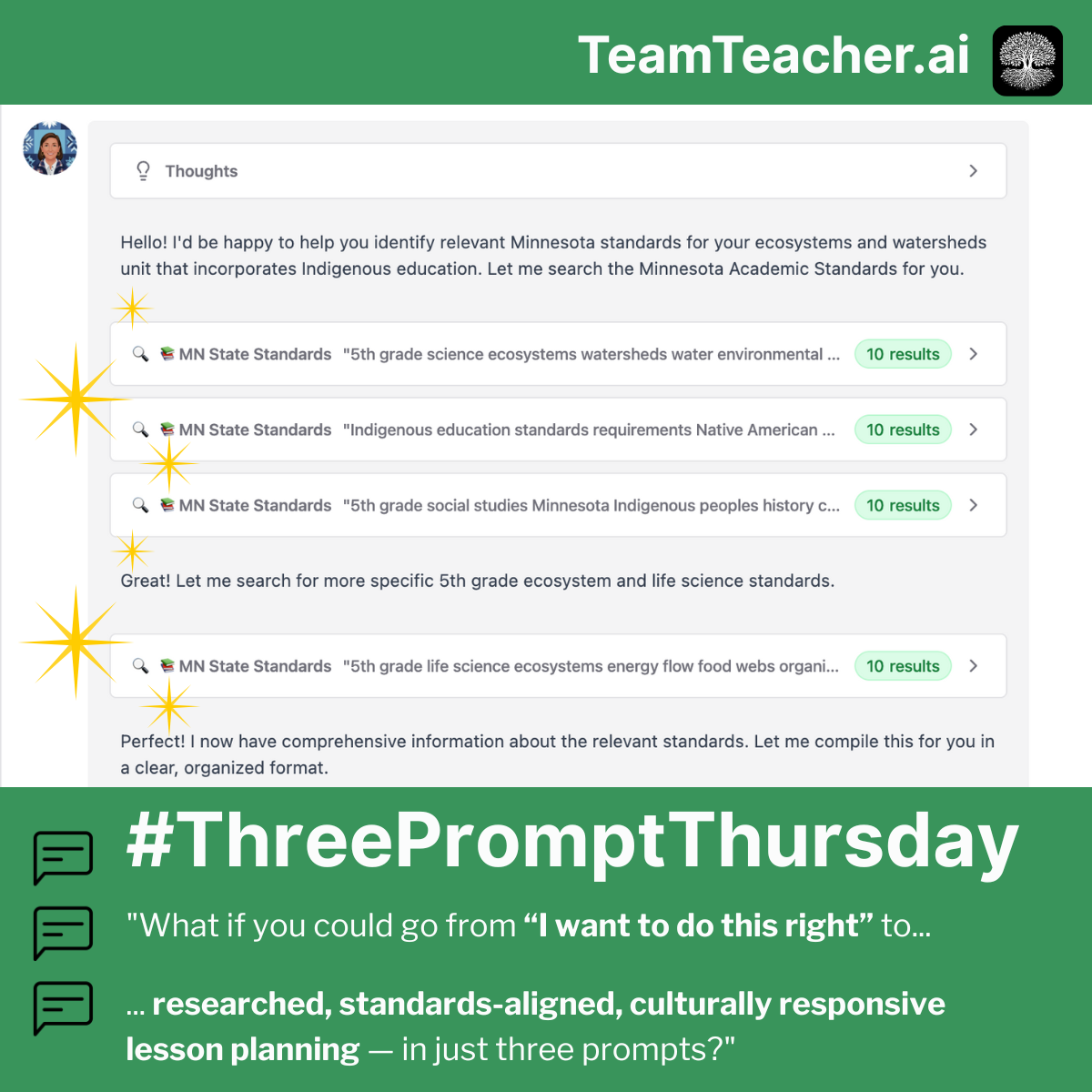
You want to ensure your students get accurate, respectful Indigenous education. But finding trustworthy sources, navigating complex histories, ensuring cultural accuracy, AND aligning to standards? That's a lot when you're already juggling everything else.
Turn your intention into researched, standards-aligned, culturally responsive content with built-in verification guidance.
The Three Prompts
🎯 Prompt 1: Standards Alignment
I'm planning to teach [topic/unit] to my [grade level] students. Can you help me identify relevant standards from [your state/Minnesota Academic Standards] that would support student learning about Indigenous peoples, including both content standards and any specific requirements around Indigenous education or cultural competency?
What this does: Establishes your foundation by identifying relevant academic standards and any state-specific Indigenous education requirements, ensuring your lesson is aligned from the start.
🔍 Prompt 2: Research Accurate Information
Now, I want to ensure I'm teaching accurate, respectful information about the Indigenous peoples whose land [specific location/region] is/was on. Can you help me research: (1) which Indigenous nation(s) are connected to this land, (2) key historical and contemporary information, and (3) where I should verify this information with tribal resources or Indigenous scholars? Please flag anything you're uncertain about.
What this does: Guides research while building in verification checkpoints, acknowledging AI limitations and directing you to authoritative tribal and Indigenous sources.
📚 Prompt 3: Build the Resource
Using the standards and information we've identified, please create an [inquiry lesson/student research guide/classroom activity] that integrates this Indigenous perspective and knowledge. Include: (1) clear learning objectives tied to the standards, (2) accurate information with source citations, (3) questions that promote critical thinking, and (4) guidance on where my students and I should verify information with tribal or Indigenous sources.
What this does: Transforms your research into classroom-ready materials with built-in verification guidance for both you and your students.
How to Adapt This 🔧
- Different locations: Customize for any geographic region or Indigenous nation
- Different grade levels: Adjust complexity and standards references for K-12 contexts
- Cross-curricular integration: Use with social studies, language arts, science, or arts curricula
What You'll Get ✨
- Standards-aligned framework specific to your state/curriculum requirements
- Research guidance with clear verification checkpoints and tribal resource connections
- Classroom-ready lesson or activity with learning objectives and critical thinking prompts
- Built-in guidance for students to engage with primary sources and tribal resources
🌳 Pro tip: This workflow doesn't replace connecting with local tribal education resources or your professional judgment. It gives you a foundation to build from—with clear guidance on where to verify and deepen your learning alongside your students.
Minnesota teachers: Diane (our Minnesota specialist) has access to the complete MN K-12 Academic Standards Knowledge Base, including Indigenous Education requirements.
Want to join the conversation about this? Check out the original #ThreePromptThursday LinkedIn post